
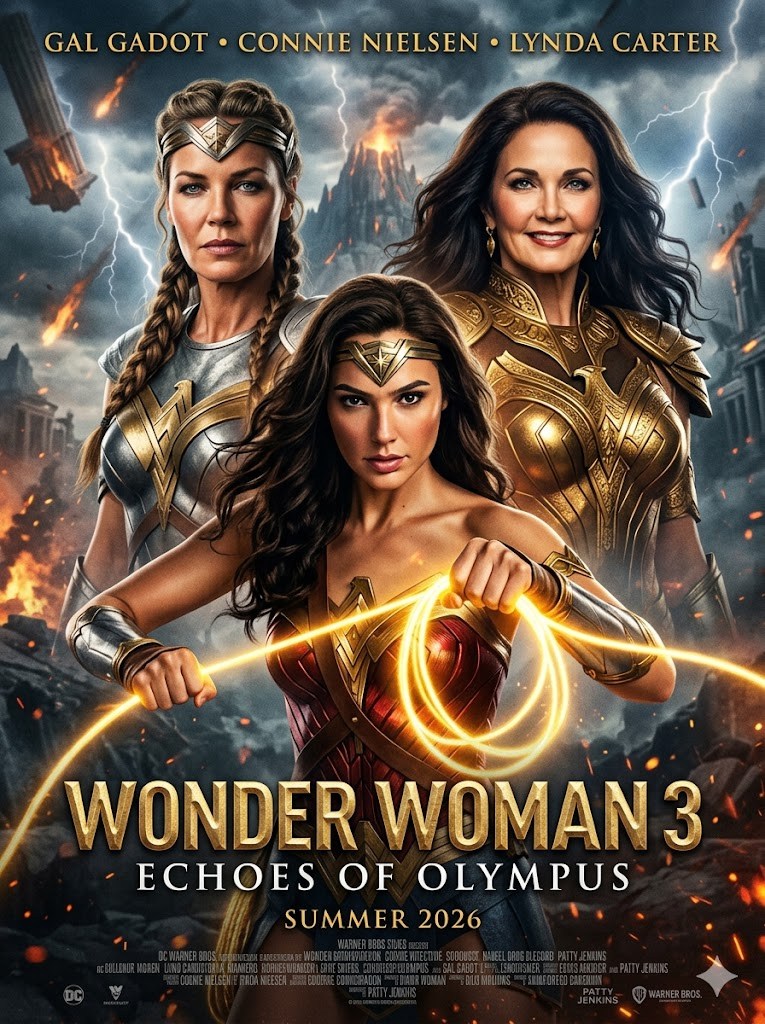
In a world where myth refuses to stay buried, Wonder Woman 3: Echoes of Olympus (2026) rises as a divine, awe-inspiring clash between gods and humanity 🌌⚔️. This is not just a battle… it’s the return of ancient power to a modern world unprepared for its wrath.
At the center stands Gal Gadot as Wonder Woman 🛡️ — no longer just a hero, but a fully realized goddess of strength, compassion, and unbreakable will 💫. With the glowing Lasso of Truth ⚡, she stands as the ultimate protector of both mortals and myth.
Beside her are legends reborn 👑 — Lynda Carter as the golden warrior Asteria ⚔️✨, and Connie Nielsen as Queen Hippolyta 👑, guiding Diana with wisdom forged through centuries.
But peace was only ever an illusion ⚠️.
From the depths of Tartarus 🌑, ancient magic awakens — unleashing monstrous beasts 🐉 and rogue deities bent on reclaiming dominion over the world of man 👁️.
The result is chaos on a mythic scale 💥 — cities shaken by divine power 🌆⚡, skies torn by godly conflict 🌩️, and humanity caught between forces beyond comprehension.
Visually breathtaking and emotionally resonant 🎥✨, the film blends epic action with timeless mythology — where every clash feels like legend being written in real time.
But beneath the spectacle lies a deeper truth 🖤:
True strength is not measured by power… but by the will to protect.
Because when gods walk among us…
only a goddess can stand against them. 🩸
🖤 Because in the echo of Olympus…
⚡ destiny is eternal.
⭐ Early Rating: 9.6/10 – A powerful, mythological epic that elevates Wonder Woman into a truly divine cinematic force