
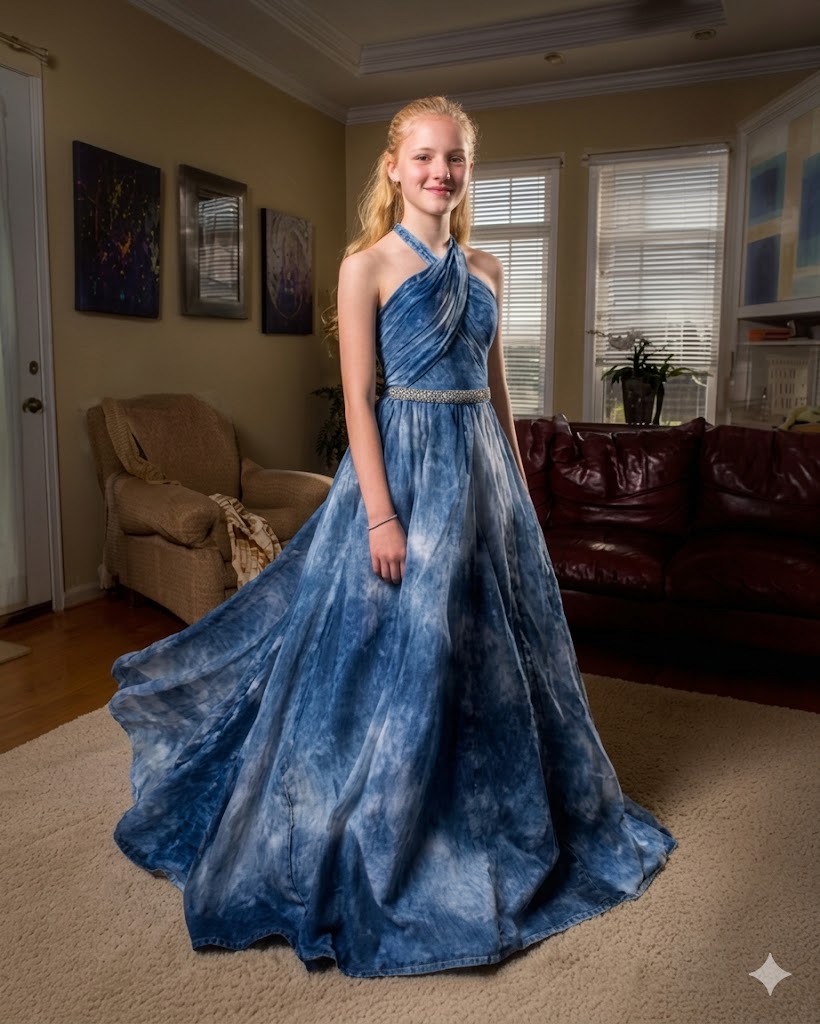
“Prom dresses are a ridiculous waste of money.”
My stepmom didn’t even bother to look up when she said it. Her fingers kept scrolling across her phone like I wasn’t even standing there.
I stood frozen in the kitchen, clutching the crumpled school flyer. The bold letters “PROM DEADLINE” felt heavier than they should’ve. I had rehearsed this conversation all afternoon—what to say, how to say it, how not to sound desperate.
“Mom left money for things like this,” I said softly, almost afraid my voice would crack.
Carla let out a short, sharp laugh.
“That money keeps this house running now,” she replied, finally glancing at me—but only for a second. “And honestly? No one wants to see you prancing around in some overpriced princess costume.”
Then, as if to underline her point, she dropped her brand-new designer handbag onto the counter.
The tag was still hanging from it.
That sound—the soft thud of leather hitting marble—felt louder than anything she said.
My dad passed away last year. A sudden heart attack. No warning. One day he was there, the next he wasn’t.
And after that… everything changed.
Carla took control of everything—every bill, every account, every dollar. Including the savings my mom had carefully set aside for me and my little brother. Money meant for moments like this. Milestones. Memories.
Gone.
Just like that.
So that was it.
No dress.
No prom.
No moment that was supposed to feel like a normal teenage memory.
I nodded like I understood, like I accepted it, and quietly walked back to my room. I didn’t slam the door. I didn’t argue.
I just sat on my bed and stared at the flyer until the words blurred.
I told myself I wouldn’t cry.
But grief doesn’t ask for permission.
And apparently, neither does love.
Because Noah heard everything.
My little brother—fifteen years old, quieter than he used to be, carrying more than any kid should. Last year, he signed up for a sewing class because the woodworking shop was full.
The boys at school didn’t let him forget it.
They mocked him. Laughed. Called him names.
And eventually, Noah stopped talking about it.
Stopped bringing it up.
Stopped letting anyone see that part of him.
Until that night.
He knocked on my door, holding a stack of old jeans—faded blues, worn edges, pieces of a life we used to have.
Mom’s jeans.
She used to collect them. Said every pair had a story.
Noah looked at me, nervous but determined.
“You trust me?” he asked.
I didn’t even hesitate.
“Always.”
For the next two weeks, everything changed.
Our quiet kitchen became a workshop.
Late nights. Whispered conversations. The soft hum of a sewing machine echoing through the house long after Carla went to bed.
Needles. Threads. Fabric spread across the table.
Noah worked like he had something to prove—not to the world, but to himself.
Piece by piece, he stitched something extraordinary.
Different shades of denim woven together like fragments of memory.
Light blues from Mom’s summer jeans.
Darker tones from the ones she wore on long drives.
Patches that still carried the faintest scent of her perfume.
It wasn’t just a dress.
It was a story.
It was love.
It was home.
The morning of prom, Carla saw it.
And just like that—she laughed.
Not a small laugh. Not a nervous one.
A loud, mocking, cutting laugh.
“That,” she said, pointing at the dress, “is the most PATHETIC thing I’ve ever seen.”
Noah froze.
I felt something inside me crack.
“If you wear that,” she continued, smirking, “the whole school will laugh at you.”
For a second, I almost believed her.
Almost.
But then I looked at my brother.
At his tired eyes. At the small cuts on his fingers. At the quiet hope he was trying so hard to hide.
And I knew.
“I’m wearing it,” I said.
That night, I walked into prom wearing that dress.
Every step felt like a risk.
Every whisper in the room felt louder than it should.
But then something unexpected happened.
People stopped.
They stared—but not the way Carla said they would.
Not with laughter.
With awe.
“Did you MAKE that?” someone asked.
“It’s beautiful,” another said.
Teachers smiled.
Students gathered.
Phones came out—not to mock, but to capture something different.
Something real.
But Carla wasn’t done.
She showed up too.
Standing near the back with her phone raised, whispering to other parents, barely hiding her excitement.
“I can’t wait to record this disaster,” she said under her breath.
And then—
My name was called.
I stepped onto the stage.
The lights hit me.
The music started…
…and then suddenly stopped.
The entire room fell silent.
Confused murmurs spread across the crowd.
The principal stepped forward, holding a microphone.
But he wasn’t looking at me.
He was staring straight into the audience.
At Carla.
He walked down from the stage, slow and deliberate, until he stood right in front of her.
Then he raised the microphone.
“Zoom in on THIS woman,” he said, his voice calm—but sharp enough to cut through the silence.
The cameraman obeyed.
All eyes turned.
Carla’s confident smile faltered.
“Because I think I know her…” he continued.
The room held its breath.
“You’re the same person,” he said slowly, “who contacted the school board last month… trying to pull funding from our student creative programs.”
A ripple of shock moved through the crowd.
Carla’s face went pale.
“Yes,” he went on, “including the sewing class.”
Noah’s sewing class.
The same class she probably called “useless.”
The same class that gave my brother the courage to create something beautiful.
The principal turned back toward the audience.
“Tonight,” he said, gesturing toward me, “we are looking at what those programs create.”
He paused.
“Talent. Courage. And something money can’t buy.”
The room erupted.
Applause. Loud. Unstoppable.
Not for Carla.
Not for anything fake.
But for truth.
For effort.
For a fifteen-year-old boy who turned grief into art.
Carla slowly lowered her phone.
No one was looking at her anymore.
No one cared about her handbag.
Or her opinion.
Because karma didn’t need to shout.
It just needed the right moment.
And that night—
It had a microphone.