
The Price of a Song
Music was the heartbeat of our home. My thirteen-year-old son, David, didn’t just play the guitar; he lived through it. For his last birthday, we had saved for months to buy him a beautiful, sunburst acoustic—not a rare vintage, but a high-quality instrument that cost more than our monthly rent. It was his most prized possession.
A few days ago, while gathering laundry from his room, I noticed an unsettling void in the corner. The stand was empty. The leather case was gone. Panic flared in my chest—had we been robbed?
When David came home, I cornered him. “David, where is your guitar? Is it at a friend’s house?”
He wouldn’t look at me. His shoulders slumped, and his voice was barely a whisper. “Mom, please don’t be mad… I sold it.”
I froze, the words stinging like a slap. “You sold it? David, we sacrificed so much for that gift. Why?”
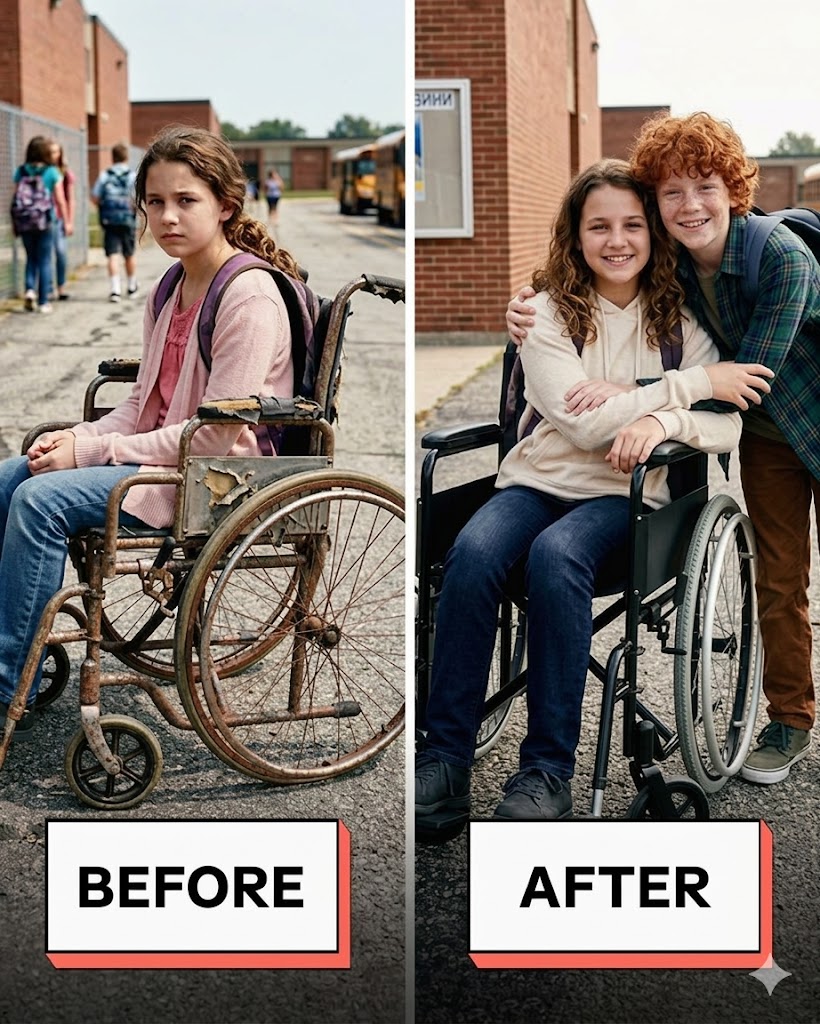
Finally, he looked up, his eyes shimmering with unshed tears. “It’s Emily, Mom. You’ve seen her wheelchair. The frame is rusted, the left wheel locks up every few meters, and her father lost his job months ago. She spent all of recess just sitting in one spot because she was too embarrassed to ask for help moving. I couldn’t just keep playing music while she was trapped in that broken chair.”
The anger in my heart evaporated, replaced by a wave of humbling pride. I pulled him into a silent hug. My young son had traded his passion for someone else’s freedom. “You’re a good man, David,” I whispered. “Just… next time, let’s do these things together.”
The following afternoon, David delivered the surprise. I watched from the car as Emily saw the brand-new, lightweight titanium wheelchair. She didn’t just smile; she broke down, her hands trembling as she touched the pristine wheels. It was a moment of pure, cinematic humanity.
However, the warmth of that moment was shattered the next morning.
At 7:00 AM, a heavy, rhythmic pounding at the front door woke us. I threw on a robe and opened it to find two uniformed police officers standing on the porch, their patrol car’s lights casting a cold blue glow over the yard. My blood turned to ice.
“Ma’am, is this the residence of David Miller?” the taller officer asked, his face unreadable.
David crept out of his room, his face pale, his hands shaking. He looked so small against the backdrop of the law.
“Yes,” I managed to choke out. “I’m his mother. What… what is this about?”
“We need you and your son to step outside immediately, Ma’am,” the officer commanded.
“What for? What’s going on? He’s just a child!” I cried out, my knees buckling. I reached back to grab David’s hand, ready to shield him, my mind racing through a thousand terrifying possibilities. Had the sale of the guitar been illegal? Was there a misunderstanding at the shop?
We stepped onto the porch, bracing for the worst. But as we looked toward the street, my breath caught in my throat.
Beyond the officers, a small crowd had gathered. Emily’s parents were there, standing next to a sleek, black SUV. The officer turned to David, a small smile finally breaking his professional mask.
“Son,” the officer said, “the shop owner you sold that guitar to is my brother. He told me a story about a kid who gave up his music for a friend. He didn’t feel right keeping that guitar.”
He reached into the back of the patrol car and pulled out the familiar leather case.
“The local precinct and the shop owner decided to chip in. Emily gets her chair, and you… you get your music back. We just needed you outside to see that some debts are paid in full by the community.”
As David took the guitar back, his hands trembling, I realized that while my son had tried to change one girl’s world, he had ended up changing ours, too.